


For the past three months, my work has taken me frequently onto the roads of Ghana, including journeys towards the Aflao border, the major gateway between Ghana and Togo.
During these journeys, I have observed something that increasingly concerns me,not simply as a private citizen, but as someone who believes strongly in Ghana’s national security, economic development and social stability.
I have noticed an increasing presence of foreign nationals, particularly children, on our streets and at major intersections, engaging in begging and selling small items such as shoe polish and other minor commodities.
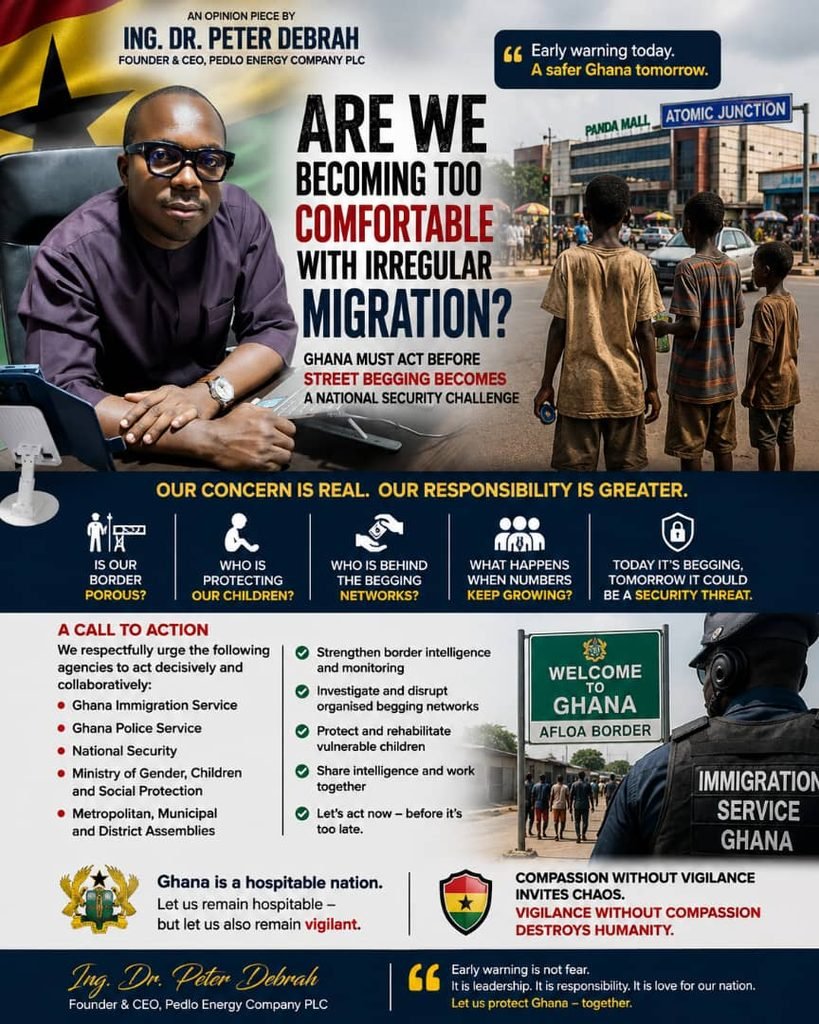
In recent weeks, the visibility of these children appears to have increased considerably in parts of Accra. Around places such as Panda Mall and Atomic Junction, for example, I have personally observed groups of young foreign children approaching motorists and pedestrians for money.
This raises a very important question: Are we adequately monitoring what is happening at our borders and on our streets?
I am not suggesting that every foreign national entering Ghana is a security threat. Far from it.
Ghana has historically been a welcoming country. We have hosted migrants, refugees, traders, workers and families from across Africa and beyond. Our membership of ECOWAS also creates legitimate rights of movement for citizens of member states.
But free movement must not become uncontrolled movement, and humanitarian compassion must not become an excuse for organised exploitation, trafficking or abuse of immigration procedures.
The Ghana Immigration Service itself has acknowledged the seriousness of the problem.
In April 2026, the Service conducted an intelligence-led operation in Kumasi and rounded up 606 people, including 381 children, in connection with exploitative migrant street-begging networks.
The GIS said many of those rescued were believed to be victims of human trafficking and forced begging.
In Greater Accra, another April operation encountered 305 West African nationals, including 113 children, as part of efforts to disrupt organised street-begging and trafficking networks. These numbers should make every Ghanaian pause and think.
THE QUESTION IS BIGGER THAN BEGGING
When we see a child standing beside a busy road asking motorists for money, our first instinct may be compassion.
And compassion is good. But government must also ask:
📍Who brought that child here?
📍Who is responsible for the child?
📍Where is the child living?
📍How did the child enter Ghana?
📍Who receives the money?
📍Are these children travelling independently, or are organised networks moving them from one location to another?
📍Are they attending school?
📍Are they being trafficked or exploited?
📍These are not questions ordinary citizens can answer.
They require intelligence, immigration profiling, child-protection investigations and cooperation among the Ghana Immigration Service, Ghana Police Service, National Security, the Ministry of Gender, Children and Social Protection and other relevant institutions.
WHAT IS HAPPENING AROUND OUR BORDERS DESERVES ATTENTION
The Aflao corridor is strategically important. It is one of Ghana’s major entry points, and border management and the prevention of unauthorised crossings are important parts of Ghana’s immigration responsibilities.
In June 2026, the Aflao Sector Command reported that more than 1,005 irregular immigrants had been intercepted and removed between April and June.
The report stated that a significant number were women and children, with some allegedly trafficked under false promises of employment. It also reported cases involving children being used for street begging.
Earlier, in May 2026, immigration authorities in the Volta Region intercepted suspected Nigerien migrants who were believed to have entered Ghana through unapproved routes around Aflao.
These developments do not automatically mean that Ghana’s border is “porous” in the sense that the state has lost control. But they certainly justify asking whether our border surveillance, intelligence gathering and enforcement systems are keeping pace with the changing patterns of migration.
That is the question I believe we should be asking.
FROM BEGGING TO ORGANISED NETWORKS
One of my greatest concerns is not the individual child on the street. It is the possibility of an organised system behind the child.
If authorities remove street beggars from our roads and, shortly afterwards, new groups appear using different methods—selling small items while simultaneously begging,we need to understand the organisation behind the movement.
📍Is this spontaneous migration?
📍Is it family migration?
📍Is it economic migration?
📍Is it trafficking?
📍Is it organised street begging?
📍Or is there a combination of all these factors?
We cannot make assumptions.
We must investigate. The Ghana Immigration Service has already warned that organised street begging can be connected to networks exploiting vulnerable migrants, particularly women and children.
That should be enough reason for a serious national conversation.
THE SUDANESE QUESTION AND EVERY OTHER NATIONALITY
I have personally noticed what appears to be increasing numbers of Sudanese children and other foreign nationals on Ghanaian streets.
But I want to make one thing clear: this is not an attack on Sudanese people, Nigeriens, Nigerians, Burkinabes or any other nationality.
People fleeing conflict, poverty or difficult circumstances deserve dignity and humane treatment.
The issue is not nationality. The issue is whether people entering, residing and working in Ghana are being properly documented, monitored and protected, and whether vulnerable children are being exploited. Ghana must remain compassionate without becoming careless.
COULD THIS BECOME A SECURITY PROBLEM?
This is where we need to be particularly thoughtful. I do not believe it is responsible to say that today’s street beggar will automatically become tomorrow’s criminal.
That would be unfair and unsupported. But equally, it would be irresponsible for authorities to ignore the possibility that large-scale undocumented migration, human trafficking, child exploitation and poorly monitored communities can create vulnerabilities that organized criminal networks may eventually exploit.
Ghana’s Immigration Service has itself raised concerns about irregular migration, child trafficking, organised street begging and other organised criminal activities.
Therefore, prevention is far better than waiting for a crisis. National security is not only about responding after something happens. National security is also about identifying emerging patterns early.
WHAT SHOULD GOVERNMENT DO?
I respectfully call on the Ghana Immigration Service, Ghana Police Service, National Security, Customs Division, Ministry of Gender, Children and Social Protection and Metropolitan/Municipal authorities to consider a coordinated assessment of this emerging situation.
📍Better intelligence at the borders. Authorities should identify the routes, transport operators, facilitators and networks involved in bringing vulnerable migrants into Ghana.
📍Stronger profiling and documentation. Foreign nationals entering Ghana should be properly documented and their immigration status established in accordance with Ghanaian law and applicable regional protocols.
📍Protection of children.
Every foreign child found begging or selling items on the streets should be treated first as a potentially vulnerable child not simply as an immigration offender.
📍Investigation of the people behind the children. If children are being transported, controlled or exploited for begging, authorities should pursue the organisers rather than merely removing the children from the streets.
📍Intelligence sharing.
Immigration, Police, National Security, social welfare authorities and border communities must share information quickly.
📍Transport monitoring. Where patterns suggest that groups of vulnerable migrants are being transported into Ghana for specific purposes, transport operators and facilitators should be investigated within the law.
📍Public reporting mechanisms.
Citizens should have simple and reliable channels for reporting suspected trafficking, child exploitation and irregular migration.
AND WHAT ABOUT THE AFLAO BORDER?
My question to the authorities is simple:
Are we seeing the beginning of a new migration pattern that requires a stronger response?
I would like the Ghana Immigration Service and our national security authorities to tell Ghanaians what they are seeing.
📍Are there new routes?
📍Are there new networks?
📍Are children being transported deliberately?
📍Are there organised groups coordinating street begging?
📍Are our border communities seeing unusual movements?
📍Are there intelligence reports that the public should know about?
These questions should not be interpreted as hostility towards foreigners.
They are questions about the capacity of the Ghanaian state to understand and manage migration.
GHANA MUST REMAIN GHANA
We must never lose our humanity.
But we must also never lose our vigilance. A country can be welcoming while still having strong borders.
A country can respect ECOWAS free movement while still enforcing immigration laws. A country can protect refugees and vulnerable children while still investigating trafficking networks.
And a country can be compassionate without surrendering its responsibility to protect its citizens.
The streets of Accra should not become the final destination for vulnerable children brought across borders.
Our borders should not become corridors for trafficking.
And our compassion should not be exploited by organised networks.
This is not a call for hostility. It is a call for intelligence, vigilance and responsible governance.
I therefore urge the Ghana Immigration Service, Ghana Police Service and National Security to investigate the changing patterns of foreign street activity we are witnessing in our cities and along our border corridors.
Let us investigate today not tomorrow.
Because when it comes to national security, early warning is always better than late reaction.
Ghana is a hospitable nation. Let us remain hospitable but let us also remain vigilant.