


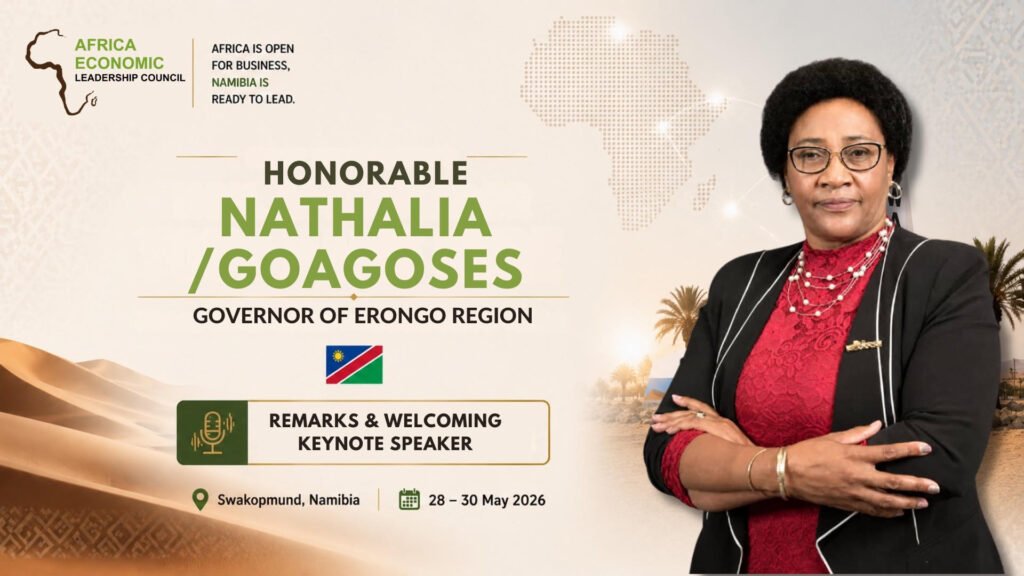
Erongo Governor Nathalia Goagoses has called for accelerated industrialization, stronger regional integration, and improved access to African markets, saying the African Continental Free Trade Area (AfCFTA) presents a historic opportunity to transform the continent’s economic future.
Speaking at the Invest in Africa 2026 Trade Expo and Business Summit in Swakopmund under the theme “Unlocking Africa’s Trade, Investment and Industrial Growth,” Goagoses said Africa stands at the threshold of transformative change and must seize the opportunities presented by the AfCFTA.
“The AfCFTA is more than a trade agreement,” she said. “It is a bold continental commitment to reimagine Africa’s economic destiny by dismantling barriers, expanding market access and strengthening regional value chains.”
The governor noted that projections by the United Nations Economic Commission for Africa (UNECA) indicate that effective implementation of the agreement could boost intra-African trade by as much as 45% by 2045.
She highlighted Namibia’s AfCFTA National Implementation Strategy 2022–2027, which is aligned with Vision 2030 and aims to accelerate economic growth, reduce inequality, and create jobs through increased participation in continental trade.
According to Goagoses, government and development partners have already developed a practical guide for trading under the AfCFTA, alongside an integrated information portal designed to help businesses overcome market access and information challenges.
Turning to industrialisation, the governor said sustainable growth requires more than increased production.
“Industrialisation is about building resilient, inclusive and environmentally responsible industries that create lasting value for our people,” she said.
She noted that Namibia is repositioning its mining and energy sectors to focus on value addition, beneficiation, renewable energy, and green technologies in order to strengthen both national and continental competitiveness. Energy, she said, remains a cornerstone of Namibia’s industrialization strategy and a key enabler of AfCFTA success.
“Energy should not be viewed merely as a sector, but as a strategic enabler of industrialisation, trade and regional integration,” Goagoses said.
She highlighted ongoing investments in solar and wind energy, transmission infrastructure and the emerging green hydrogen sector, while also pointing to opportunities arising from oil and gas exploration.
According to the governor, these developments are expected to drive local participation, skills development and downstream value creation.
Goagoses further stressed that intra-African trade must become “the lifeblood of Africa’s industrialisation,” reducing dependence on external markets, creating jobs for young people and fostering innovation across borders.
She reaffirmed Namibia’s commitment to strengthening agro-processing, manufacturing and energy partnerships while empowering small and medium enterprises (SMEs) to participate meaningfully in regional value chains.
However, she cautioned that achieving sustainable industrialisation will require significant investment in infrastructure, skills development and digital transformation, as well as harmonised policies that facilitate the seamless movement of goods, services and people across the continent.
“The success of AfCFTA will depend on strong political will and collective action from governments, businesses and development partners,” she said.
Concluding her address, Goagoses said the AfCFTA represents far more than a mechanism for market access.
“AfCFTA is a pathway to uplift communities, reduce inequalities and secure Africa’s rightful place in the global economy,” she said.
She reaffirmed Namibia’s commitment to working with African partners to ensure industrialisation is inclusive, trade is transformative and the vision of a unified African market becomes a reality.
Story written by NANA ACHIAA ABOAGYE


