


Vice President Prof. Naana Jane Opoku-Agyemang reaffirmed the government’s dedication to transforming Ghana’s correctional system during a high-level meeting with the leadership of the Ghana Prisons Service on Monday, August 18, 2025.
The meeting, held at the seat of government, brought together the service’s hierarchy led by Director General Mrs. Patience Baffoe-Bonnie.
The Vice President’s engagement with the prisons’ leadership signals the Mahama administration’s prioritization of penal reform as a cornerstone of its governance agenda.
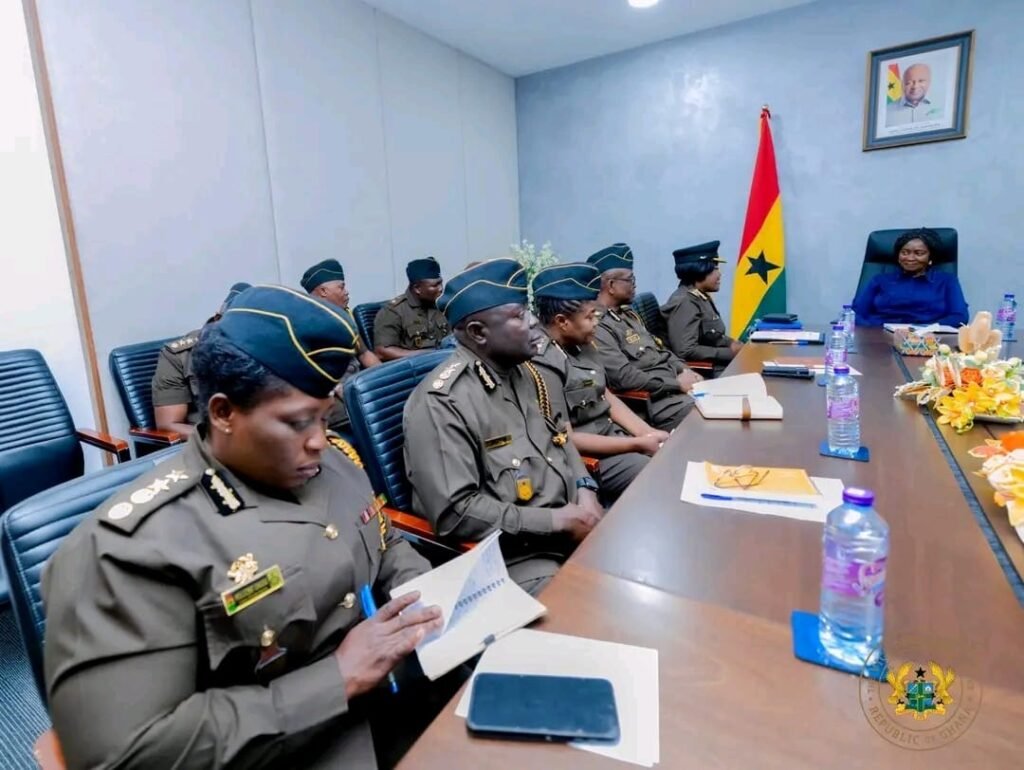
During the discussions, Prof. Opoku-Agyemang emphasized the critical need for comprehensive public education campaigns to shift societal perceptions about the role of correctional facilities in national development.
Central to the meeting’s agenda was the exploration of collaborative frameworks between the Ghana Prisons Service and other state agencies, as well as media partnerships aimed at enhancing public understanding of correctional work.
The Vice President underscored that effective prison management requires coordinated efforts across multiple sectors of government and civil society.
Mrs. Patience Baffoe-Bonnie, who was appointed Director General in March 2025 by President Mahama, has brought over 37 years of corrections and security expertise to the role.
Under her leadership, the service has been implementing various innovative programs, with agricultural initiatives receiving particular recognition from the Vice President during Monday’s meeting.
Prof. Opoku-Agyemang specifically commended the service’s agricultural campaign, describing it as a promising intervention that demonstrates the potential for productive engagement within correctional facilities.
These agricultural programs represent a shift toward rehabilitation models that equip inmates with practical skills while contributing to food security initiatives.
The vice president’s assurance of government support comes at a time when Ghana’s correctional system faces significant challenges, including overcrowding, inadequate facilities, and limited resources for rehabilitation programs.
Recent initiatives by the Ghana Prisons Service have focused on transforming prisons from places of punishment to spaces of hope, healing, and productivity.
The commitment to improving prison conditions extends beyond infrastructure to encompass comprehensive reform programs aimed at the successful reintegration of former inmates into society.
Prof. Opoku-Agyemang emphasized that ensuring dignified conditions for inmates is not merely a moral imperative but a fundamental responsibility of a progressive nation.
This meeting occurs within a broader context of prison sector reforms under the Mahama administration.
Earlier today, President Mahama granted amnesty to 998 prisoners nationwide, following recommendations from the Prisons Service Council and consultations with the Council of State, demonstrating the government’s multifaceted approach to correctional system improvement.
The vice president’s engagement with prison leadership reflects a strategic approach to addressing systemic challenges through dialogue, resource allocation, and policy reform.
The emphasis on inter-agency collaboration suggests recognition that effective correctional services require coordinated support from various government departments and civil society organizations.
As Ghana continues to develop its correctional philosophy, the focus on rehabilitation over mere incarceration represents a significant policy evolution.
The government’s commitment, as articulated by Prof. Opoku-Agyemang positions the prison service as a vital component in the country’s social development framework, with the ultimate goal of reducing recidivism and promoting successful community reintegration.
Story Written By Prince Asante Kwarteng | Kobby Kyei News


