


Professor Augustina Naami, an Associate Professor of Disability and Social Work at the University of Ghana, with a career on dismantling the barriers that hold back persons with disabilities.
With degrees from the University of Ghana, the University of Chicago, and a PhD from the University of Utah, plus a graduate certificate in Interdisciplinary Disability Studies, her expertise is matched only by her passion.
“I can do all things through Christ who strengthens me.” – Philippians 4:13
The verse echoed in my mind as I approached the starting line of the inaugural ABSA Marathon in Accra, my racing wheelchair positioned among dozens of other determined athletes.
Thirty minutes early, as always, I sat with hands gripping the push rims, heart steady with the familiar weight of faith that has carried me through every challenge life has presented from navigating academia as a woman with a disability to challenging societal perceptions through my research and advocacy work.
This wasn’t just another race. This was the maiden edition of what would become one of Ghana’s premier marathon events, and I was about to become part of its history in the 10-kilometer wheelchair division.
As I surveyed the field of competitors, I thought about the broader significance of this moment. As someone who has spent years advocating that we must “rethink disability” because “it is not the problem,” my presence here represented more than personal athletic ambition.
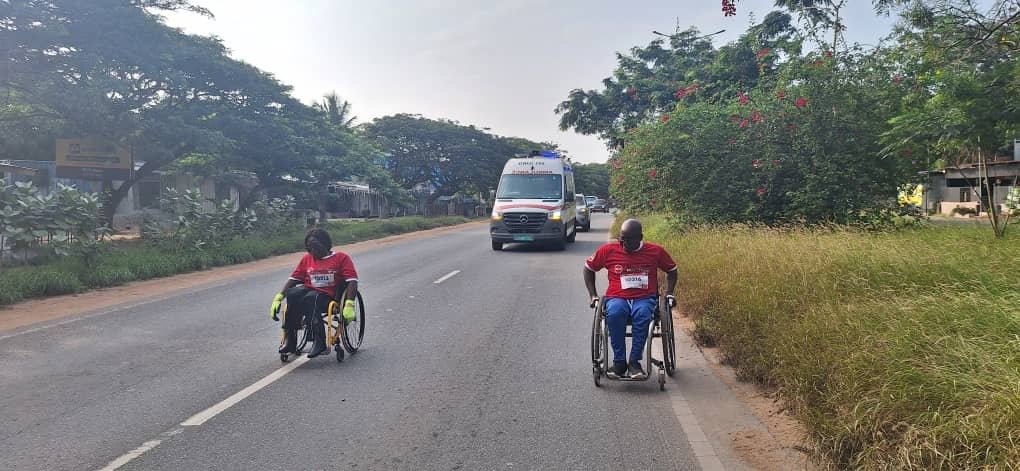
I was living proof of the very principles I preach. From Academic Theory to Athletic Practice My journey to this starting line began long before my months of dawn training sessions through Accra’s streets.
It started in lecture halls at the University of Ghana, University of Chicago, and University of Utah, where I developed the theoretical framework to understand disability not as individual limitation, but as social construction.
My research on the “triple disadvantage of sexism, ableism, and poverty” that women with disabilities face had always been deeply personal, but it was also deeply academic.
Now, sitting in my racing wheelchair surrounded by athletes who saw me simply as a competitor, I was about to transform years of theoretical advocacy into visceral, visible demonstration.
Every wheel rotation through these 10 kilometers would be a moving argument for the “power in disability inclusion” that I had written about in countless papers and discussed in endless conferences.
The decision to participate hadn’t come lightly. As someone who regularly leads campaigns where over 200 University of Ghana students raise awareness about disability challenges, I understood the symbolic weight my participation would carry.
Would I be seen as Professor Naami the advocate making a point, or simply as another athlete pursuing a personal challenge? The beauty of sport, I hoped, was that it would strip away the academic titles and social positions, reducing us all to the fundamental human desire to test our limits and pursue excellence.
The Scholar Who Became an Athlete Training for this marathon had required me to step outside the comfortable confines of university life and into the raw, demanding world of endurance athletics.
Dawn became my companion as I rolled through University of Ghana’s quiet streets, building not just physical endurance but a different kind of confidence than what I had developed through academic achievements.
These solitary morning training sessions gave me time to reflect on the intersection of my professional advocacy and personal experience. Every time I navigated a poorly maintained road surface or dealt with curious stares from early morning commuters, I was reminded of the daily obstacles that persons with disabilities face, obstacles that become invisible to society precisely because we’ve learned to navigate them so efficiently.
My students who participate in our disability awareness campaigns walk through communities with placards, engaging market vendors and taxi drivers in conversations about inclusion and accessibility.
During my training runs, I found myself becoming a different kind of mobile advocate demonstrating through action rather than words that persons with disabilities are not defined by limitations but by what we choose to pursue.
Each training session was anchored by the same biblical verse that has guided my academic career and personal life: “I can do all things through Christ who strengthens me.”
The phrase had sustained me through the challenges of graduate school, through the process of establishing myself in academia, and through years of research that required me to confront difficult truths about how society treats its most vulnerable members.
Now it would carry me through 10 kilometers of Accra’s diverse and demanding streets.
The morning of the ABSA Marathon dawned clear and promising, with the kind of gentle coastal breeze that makes Accra beautiful for outdoor activities. Standing at Independence Square, surrounded by hundreds of fellow racers, I felt a profound sense of completion—not of the race, which hadn’t yet begun, but of a journey from theoretical understanding to practical demonstration.
The iconic square, with its towering Independence Arch, seemed an appropriately symbolic starting point. Ghana’s independence required vision, persistence, and the courage to believe that change was possible even when obstacles seemed insurmountable.
My academic work on disability rights follows a similar trajectory, slow, steady work of changing minds and systems until what once seemed impossible becomes inevitable.
The atmosphere buzzed with nervous excitement and genuine camaraderie. Volunteers moved efficiently through the crowd, checking registration numbers and offering encouragement that felt authentic rather than patronizing.
This distinction mattered enormously to me. As someone who has spent years advocating against the tendency to either ignore persons with disabilities or treat them as objects of inspiration, being seen simply as an athlete represented the kind of normalized inclusion I work toward in all my advocacy.
I whispered my verse one more time, adjusted my racing gloves, and settled into the focused mindset that had carried me through countless academic challenges. The starting line stretched before us like a threshold between theory and practice, between advocacy and demonstration.
The Deceptive Promise of Independence Square
The first stretch fulfilled all my hopes, the smooth, well-maintained roads of Independence Square allowed my wheels to find their rhythm immediately.
Around me, the field began to spread naturally as athletes settled into their sustainable paces. The crowd of spectators created a tunnel of encouragement that provided an early boost of energy and validation.
But I knew that this initial ease was deceptive. My research had taught me that accessibility is often superficial, impressive in controlled environments like ceremonial squares, but inconsistent in the real-world spaces where people actually live and work.
As we moved away from the manicured starting area into authentic urban Accra, I prepared mentally for the kinds of obstacles that would test not just my physical preparation but my philosophical commitment to the belief that barriers exist primarily in minds rather than environments.
The smooth perfection of Independence Square was preparation, not destination. Ahead lay the real test, not just of my athletic abilities, but of my conviction that persons with disabilities belong in every space, navigating every challenge, pursuing every goal that captures their imagination.
The road surface changed dramatically as we reached the extension of Labone Junction, transforming from smooth asphalt to the rough, chipped surface that characterizes much of Accra’s expanding infrastructure.
What had been predictable contact between wheel and pavement became a constant negotiation with loose stones and uneven patches that grabbed at my wheels with frustrating unpredictability.
My wheels caught and stuck repeatedly.
Each time I freed myself, I was reminded of the countless “small” barriers that accumulate to create the larger pattern of exclusion I study in my academic work.
This wasn’t just about road surfaces, it was about all the seemingly minor obstacles that society places in the paths of persons with disabilities, obstacles that become major impediments when they accumulate day after day, year after year.
My arms began to register the increased effort required to maintain momentum over the challenging surface. Other wheelchair racers around me were experiencing similar difficulties, and I could hear the frustration in their breathing patterns.
But I also heard determination, the same quality I recognize in my students when they commit to challenging societal assumptions about disability.
The voice in my head, the same one that whispers during every difficult moment in academic and personal life, suggested that perhaps this challenge was beyond my capabilities, that perhaps the smart approach would be to conserve energy and withdraw.
But I have spent too many years teaching others about resilience to surrender to that voice now.
Instead, I found myself whispering the words that have anchored every significant achievement in my life: “I can do all things through Christ who strengthens me.”
My hands found new strength, my wheels found new purchase, and I pushed forward. This wasn’t just about finishing a race but it was about proving to myself and anyone watching that the barriers we face are often less insurmountable than they appear when viewed through the lens of faith and determination.
The Society That Sees Potential
As I struggled through the challenging terrain of Labone Junction, something beautiful occurred that validated years of my advocacy work. Local residents, co-runners, passengers in trotro offered exactly the kind of authentic encouragement I had hoped to see.
Instead of the uncomfortable stares or excessive pity that persons with disabilities sometimes encounter, they provided genuine support, clapping, calling out encouragement in English and Twi, and treating me exactly as they treated every other athlete.
Their natural response reminded me why I work so hard to challenge adult prejudices, children don’t need to be taught to see beyond disability; they need to be protected from learning to see disability as limitation.
This spontaneous support embodied exactly what I advocate for in my research and teaching, a society where inclusion happens naturally, where differences are celebrated rather than pitied, and where every person’s efforts are recognized and valued.
Every cheer from the sidelines felt like validation of my belief that Ghanaians are ready for genuine inclusion; they simply need opportunities to experience it.
From Labone Junction toward Danquah Circle and the Police Headquarters, the course continued to test our resilience while showcasing the vibrant complexity of Accra.
This section took us through neighborhoods where daily life was in full swing, market women beginning their day, commuters waiting for transport and the general energy of a city awakening to possibilities.
The road surface varied constantly, demanding continuous adaptation and focus. As an academic, I’m accustomed to intellectual challenges that require sustained concentration; as an athlete, I was learning that physical challenges demand the same mental discipline. Smooth patches allowed for brief recovery, while rougher sections required careful navigation and increased effort.
Racing through these authentic neighborhoods, past the sounds and energy of real urban life, I felt deeply connected to the community I serve through my academic work.
This wasn’t a sanitized, artificial race environment; it was a journey through the actual city where persons with disabilities live, work, and pursue their dreams daily.
Every kilometer completed felt like a mobile demonstration that capability comes in many forms and deserves recognition in every context.
The Mountain in Our Path
Nothing could have prepared me for the Ako-Adjei Interchange (the Sankara overpass) that rose before us like a concrete mountain.
Looking up from the bottom, the incline seemed to stretch endlessly upward, representing exactly the kind of architectural barrier that my research identifies as a primary obstacle to full social participation.
For wheelchair users, every incline is magnified exponentially. What appears manageable to walking athletes becomes, for those of us who rely on arm strength alone, a test of every aspect of our physical and mental preparation.
As I approached the base of the overpass, my heart rate increased not just from anticipation, but from the knowledge that the next several minutes would determine whether months of training would culminate in triumph or teach me about the limits of determination.
The ascent began deceptively manageable, allowing me to maintain something close to my established rhythm. But as the grade increased, so did the demand on my cardiovascular system and the muscles in my shoulders, arms, and core.
My breathing shifted from controlled to urgent, each push of the wheels moving me forward only slightly while the summit seemed to recede rather than approach.
My arms screamed for relief, my vision narrowed to focus entirely on the patch of road immediately ahead, and I entered that zone familiar to anyone who has pushed against their perceived limitations. where the line between determination and desperation becomes beautifully, terrifyingly thin.
Sweat ran down my face and arms, and the cheerful sounds of spectators faded into background noise as my body and will engaged in the kind of conversation that defines transformative moments.
But the verse that has guided my entire career rose within me again, stronger and more insistent than ever: “I can do all things through Christ who strengthens me.” The words weren’t just comfort; they were fuel. I gripped harder, found reserves of strength I hadn’t known existed, and climbed.
Each revolution of my wheels became an act of faith, each meter gained a small victory over the voice that suggested this was impossible.
Reaching the top of that interchange wasn’t just a physical achievement but a spiritual confirmation of everything I had believed about perseverance, faith, and the strength we discover when we refuse to accept defeat.
Standing at the crest, with the road stretching out below me and the finish line measurably closer, I understood that I had just experienced something that would change how I approached challenges for the rest of my life.
From the Ridge Roundabout through to Parliament House, the road finally became an ally rather than an adversary. The smooth, well-maintained surface allowed my wheels to sing against the asphalt, and for the first time since leaving Independence Square, I allowed myself to imagine not just completing the race, but completing it with strength and dignity intact.
This section of the course took us past some of Ghana’s most significant landmarks, government buildings, cultural institutions, and symbols of national achievement.
Racing past Parliament House, I felt a profound connection to the democratic ideals it represents and to my own work advocating for the rights and full inclusion of persons with disabilities within our national life.
I began to understand that my journey was resonating with people who might never have considered the athletic capabilities of persons with disabilities.
And then, suddenly, beautifully, the finish line appeared ahead. Crossing the Line Between Theory and Practice. The final approach felt surreal, as if the morning’s challenges had compressed time and space into this singular moment of completion.
The crowds were thicker here, the energy more intense, and the realization that I was actually going to finish struck me with emotional force I hadn’t anticipated.
Eleventh place out of all the female wheelchair racers who had dared to take on this inaugural course. The number felt both significant and secondary concrete measurement of capability in a society where persons with disabilities are too often assumed incapable, but less important than the journey itself.
As I crossed that finish line with what I can only describe as a smirk of pure satisfaction, I understood that this race had been about far more than personal achievement.
By competing alongside able-bodied athletes, being cheered by diverse communities, and demonstrating the athletic capabilities that exist within the disability community, I had become a living argument for the inclusion I advocate in lecture halls and academic papers.
The race had been a 10-kilometer rolling advertisement for the potential that exists when barriers are removed and opportunities are genuinely created.
As I sat in my chair in the finish area, the satisfaction of completion warming me more than Accra’s rising sun, I understood that the ABSA Marathon was my first race, but it wouldn’t be my last.
Every future training session, every race ahead, every challenge that awaits will carry the same foundation that carried me through those 10 kilometers: unwavering faith and the understanding that our strength comes from something far greater than ourselves.
The experience taught me that preparation matters the months of dawn training, the physical conditioning, the mental rehearsal of race strategies. But it also confirmed that preparation alone isn’t sufficient.
The moments of greatest challenge require something deeper, something that transcends physical capability and enters the realm of spiritual determination.
More importantly, I now understand in my bones what I had previously known only intellectually: that every barrier overcome by a person with a disability creates space for others to follow.
My academic research provides the framework for understanding inclusion; my athletic achievement provides tangible proof that the barriers we study can be conquered.
The marathon taught me that success isn’t just about finishing but it’s about the courage to start, the persistence to continue when obstacles appear insurmountable, and the faith to believe that our goals are achievable even when the path seems impossible.
These lessons extend far beyond athletic competition into every aspect of advocacy work, where progress often feels slow and barriers seem entrenched.
“I can do all things through Christ who strengthens me.” As I reflected on the morning’s journey—from nervous anticipation at Independence Square through the trials of rough roads and challenging inclines to the triumph of crossing the finish line.
I realized that this race had become my most important research project. Not because it would generate academic papers or advance my career, but because it had transformed theoretical understanding into lived experience.
The ABSA Marathon became my personal testimony to the power of faith-driven determination, but it also served as a public demonstration that the disability community in Ghana is ready to be seen, celebrated, and included in every aspect of national life.
Every wheel rotation through those 10 kilometers was a statement about capability, every challenge overcome was a refutation of low expectations, and every cheer from the sidelines was evidence that inclusion is not just possible but inevitable when people choose to see potential rather than limitation.
The race is over, but the marathon continues. It continues every time a person with a disability chooses to pursue a dream that others consider unrealistic. It continues every time my students challenge community members to think differently about disability.
It continues every time communities choose to cheer for athletes regardless of how they move through the world. And it continues every time faith meets determination on the road to possibilities that once seemed impossible.
Just as I began, I will end with my favorite quote “I can do all things through Christ who strengthens me” Philippians 4:13.
Professor Augustina Naami is Head of the Department of Social Work at the University of Ghana. She completed the inaugural ABSA Marathon 10K wheelchair race, finishing 11th in the division.
Her research focuses on disability studies, and she regularly leads advocacy campaigns involving over 200 university students working to change societal perceptions about disability and promote genuine inclusion throughout Ghana.


